
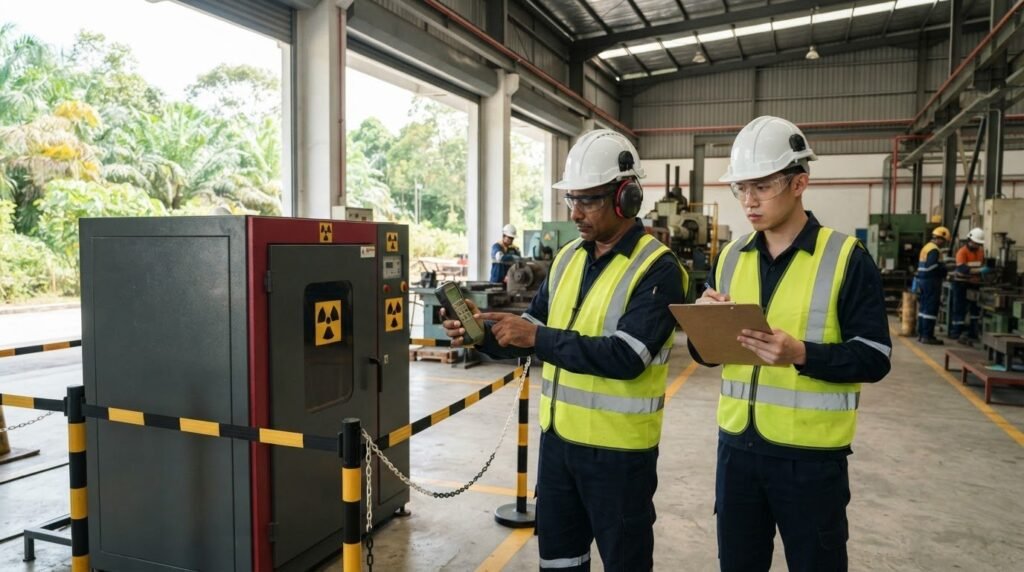
Radiation controls belong inside the workplace safety system, not beside it. In Malaysia, Regulation 23 requires licensees to employ a Radiation Protection Officer with the necessary knowledge, skill and training. Radiation protection consultancy in Malaysia can help identify radiation sources, relate their risks to workplace procedures, and recommend practical controls and monitoring.
For employers, radiation protection consultancy Malaysia is about more than recognising that radiation is present. It means translating that awareness into clear responsibilities, safe work practices and ongoing oversight. This article explains how consultancy can support that process, what a workplace review may cover, and how radiation protection fits into broader health and safety systems. It also outlines when specialist support is relevant and what to consider when planning next steps.
Key Takeaways
- Map radiation sources and connect the findings to existing workplace health and safety procedures.
- Use a clear consultancy report to translate identified risks into practical controls, assigned responsibilities and monitoring actions.
- Understand how radiation protection principles and measurement methods inform workplace monitoring arrangements.
- Assess whether consultancy or Radiation Protection Officer support is relevant to your workplace’s radiation safety needs.
Radiation protection in workplace health and safety systems
Radiation protection works best when responsibilities, work methods and monitoring are integrated into workplace health and safety systems. In Malaysia, licensing requirements and competent personnel help shape this framework.
Radiation Health and Safety Risk Assessment
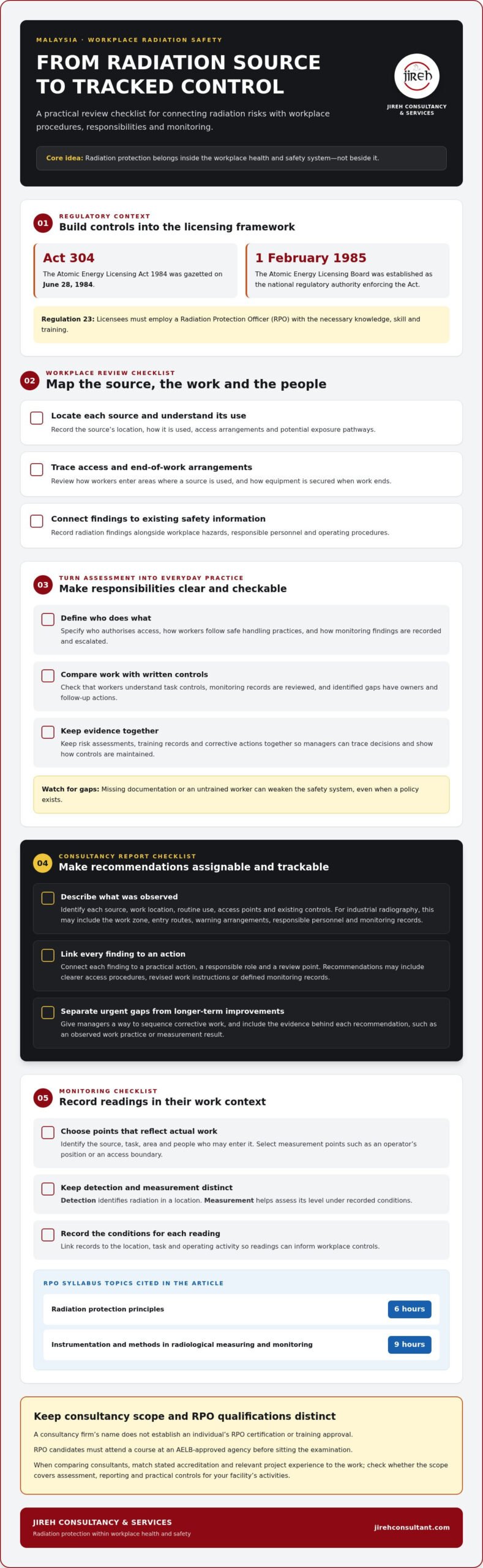
Attorney General’s Chambers of Malaysia states that the Atomic Energy Licensing Act 1984 was gazetted on June 28th 1984 as Act 304. Department of Atomic Energy Malaysia (Atom Malaysia) records the Atomic Energy Licensing Board’s establishment on 1st February 1985 as the national regulatory authority enforcing that Act. These milestones place radiation controls within Malaysia’s licensing framework.
Assess each source by its location, use, access arrangements and potential exposure pathways. For example, review how workers enter an area where a radiation source is used, and how equipment is secured when work ends. Regulation 23 requires licensees to employ a Radiation Protection Officer with the necessary knowledge, skill and training. Record findings alongside existing workplace hazards, responsible personnel and operating procedures.
Policies should turn assessment findings into defined work steps. Specify who authorises access, how workers follow safe handling practices, and how monitoring findings are recorded and escalated. Training can reinforce radiation safety principles and their practical application. Candidates for Malaysia’s Radiation Protection Officer certification must attend a course at an AELB-approved agency before sitting the examination.
Non-Compliance Penalties and Risks
Non-compliance can create regulatory and operational risks and increase the chance of workers encountering uncontrolled hazards. Licensees should treat gaps in training, procedures, access control or monitoring as issues requiring prompt attention. Legal consequences depend on the specific breach and applicable enforcement process, so a single penalty amount should not be assumed for every situation.
For practical oversight, compare work practices with written procedures and assigned responsibilities. Check that workers understand the controls for their tasks, monitoring records are reviewed, and identified gaps have owners and follow-up actions. An undocumented control or an untrained worker can weaken the safety system, even when a policy exists. Keep risk assessments, training records and corrective actions together so managers can trace decisions and show how controls are maintained.
Consultancy project reports and practical control measures
A consultancy project report should turn site observations into decisions managers can assign and track. It may identify each radiation source, its work location, routine use, access points and existing controls. For example, an industrial radiography review can map the work zone, entry routes, warning arrangements, responsible personnel and monitoring records.
Link each finding to a practical action, a responsible role and a review point. Recommendations might include clearer access procedures, revised work instructions or defined monitoring records. Separate immediate control gaps from longer-term improvements so managers can sequence corrective work. Include the evidence behind each recommendation, such as an observed work practice or measurement result.
Radiological measurements help establish the readings found in a defined location or work situation. Radiation safety courses in Malaysia include laboratory exercises on radiation detection and measurement techniques. These exercises show how instruments support detection and measurement; reports should explain where readings were taken and how they inform controls. Records are more useful when linked to a location, task and operating condition.
Compare consultants by matching their stated accreditation to the work, reviewing relevant project experience, and checking whether their scope covers assessment, reporting and practical controls. Consider whether the proposed work addresses your facility’s activities, such as industrial source use, medical imaging or research. A clear scope and evidence-based recommendations make comparisons more meaningful than broad claims.
A consultancy firm’s name does not establish an individual’s RPO certification or training approval. RPO candidates must attend a course at an AELB-approved agency before sitting the examination. Keep consultancy credentials distinct from personnel training requirements.
Support can include identifying sources, assessing work practices, preparing procedures, planning radiation detection and measurement, and recommending controls. Medical, industrial and research facilities have different needs, such as imaging workflows, industrial source access or laboratory handling. Define your facility’s activities first, then match the required work to the proposed service scope.
For a workplace-specific discussion of practical control planning, explore radiation safety review support.
Radiation protection principles and monitoring
Monitoring turns radiation protection principles into observable workplace controls. Start by identifying the source, task, area and people who may enter it. Choose measurement points that reflect actual work, such as an operator’s position or an access boundary. Record the conditions for each reading, since the location and operating activity help explain the result.
Use detection and measurement as distinct but connected steps. Detection identifies radiation in a location; measurement helps assess its level under recorded conditions. Malaysia’s Radiation Protection Officer syllabus allocates 6 hours to radiation protection principles and 9 hours to instrumentation and methods in radiological measuring and monitoring. These syllabus topics support practical understanding of instruments, readings, and monitoring methods.
A useful monitoring plan assigns responsibility, identifies locations and explains how results affect work practices. For example, a survey can check a work area and its access route, while equipment checks can establish whether instruments function as intended. Record the instrument or method used, location, task and any action taken. This makes later comparisons more meaningful.
Set the timing of surveys, equipment tests and workplace audits according to applicable licence conditions and a documented, risk-based schedule. Consider the source, work activity, changes to equipment or layout, monitoring results and previous corrective actions. Review the schedule when operations change, such as when a source is moved or access arrangements are altered. This gives a practical way to set check intervals without applying one schedule to every workplace.
During an audit, compare written controls with actual practice. Check instrument records, survey locations, staff responsibilities and how managers respond to findings. Malaysia’s Radiation Protection Officer syllabus includes monitoring in competency preparation, but workplace oversight also relies on consistent records and follow-up. Assign each corrective action to a responsible role and retain evidence of completion.
What services do radiation protection consultancies in Malaysia provide?
Consultancy support can help a facility understand its radiation-related work and organise controls around specific activities. The scope depends on the sources, work processes, workplace layout and responsibilities involved. A medical facility may focus on imaging-room procedures; an industrial site may examine source access and work-zone arrangements; a research laboratory may review handling practices and staff instructions.
Project work can include reviewing source inventories and site practices, identifying control gaps, and recommending workplace procedures. A report can connect each observation to a practical action, such as clarifying access responsibilities or documenting how monitoring results are handled. Managers can then assign actions, retain evidence and revisit controls when equipment, tasks or layouts change.
Support may also address radiation measurement and competency needs. For example, a review can identify where detection or measurement informs operational decisions, what records should accompany readings, and which roles need relevant instruction. Radiation Protection Officer (RPO) services relate to the workplace’s need for qualified radiation-safety oversight. Malaysia’s Regulation 23 requires licensees to employ an RPO with the necessary knowledge, skill, and training.
- Medical facilities: Review imaging-related work practices, access arrangements, and relevant monitoring records.
- Industrial facilities: Examine source use, work-zone controls, and responsibilities during operations.
- Research facilities: Assess laboratory procedures, source handling, and staff understanding of controls.
Define the facility type, activities and intended outcomes before setting the project scope. Compare the proposed deliverables with workplace needs, such as assessment findings, written recommendations, monitoring guidance or RPO support. Clear deliverables help managers understand what the work addresses and how to incorporate findings into existing safety procedures.
Discuss radiation safety requirements for your workplace and identify the support relevant to its activities.
When assessing advisory support, facilities can ask about relevant experience: a proposed Radiation Protection Advisor in Malaysia must have provided radiation-protection and regulatory advice as an expert to at least 5 companies.
JIREH Consultancy & Services: Radiation Protection Consultancy
JIREH Consultancy & Services provides Radiation Protection Consultancy for Malaysian workplaces reviewing radiation sources, safety procedures, controls or monitoring needs. Turn to this support when you need to connect site findings with practical workplace safety measures.
When radiation safety oversight or staff competency is also a priority, Radiation Protection Officer (RPO) Services and relevant training can support your organisation’s approach. JIREH also offers OSH Coordinator Training (Latihan Penyelaras KKP) and RBA Compliance Training, each addressing distinct workplace coordination and compliance needs.
Set out your workplace activities and the radiation protection questions you need addressed. Contact JIREH Consultancy & Services or visit jirehconsultant.com to discuss the appropriate next step.
Establish the Next Step for Workplace Radiation Safety
Start by defining what your organisation needs from its radiation safety arrangements. Identify the workplace activities in scope, the operational questions requiring attention and the internal roles involved. This gives any discussion about radiation protection consultancy in Malaysia a clear starting point, grounded in your organisation’s actual work rather than general assumptions.
JIREH Consultancy & Services offers Radiation Protection Consultancy and Radiation Protection Officer (RPO) Services for organisations addressing these needs. OSH Coordinator Training (Latihan Penyelaras KKP) may also be relevant when workplace coordination and safety responsibilities need development. Each offering serves a distinct purpose, so focus on your immediate operational need when deciding what to discuss.
Prepare a concise outline of your activities and priorities, then contact JIREH Consultancy & Services to discuss a suitable next step. A defined scope supports a more focused conversation and helps your organisation proceed with clarity.
Frequently Asked Questions
What qualifications are required for a Radiation Protection Officer in Malaysia?
Malaysia requires a licensee to employ an RPO with the necessary knowledge, skill and training under Regulation 23. Candidates for RPO certification must be at least 18 years old on the application date. They must also attend a training course at an agency approved by AELB before sitting the examination. These requirements distinguish workplace appointment responsibilities from an individual candidate’s certification pathway.
What radiation safety training and certification is available in Malaysia?
Malaysia’s RPO certification pathway includes an AELB-approved training course followed by an examination. The syllabus covers radiation protection principles, instrumentation, and radiological measurement and monitoring methods. General radiation safety courses also cover source types, radiation interactions with matter, biological effects and detection exercises. JIREH Consultancy & Services provides RPO Services; distinguish this support from formal candidate training and certification.
Which Malaysian agencies oversee radiation safety and licensing?
The Atomic Energy Licensing Board was established as Malaysia’s national regulatory authority enforcing the Atomic Energy Licensing Act 1984, according to the Department of Atomic Energy Malaysia (Atom Malaysia). AELB also approves agencies that provide the required RPO training course. For workplace administration, identify the applicable licence conditions and keep radiation-related records organised for regulatory oversight. These roles connect licensing authority, training approval, and facility-level compliance.